
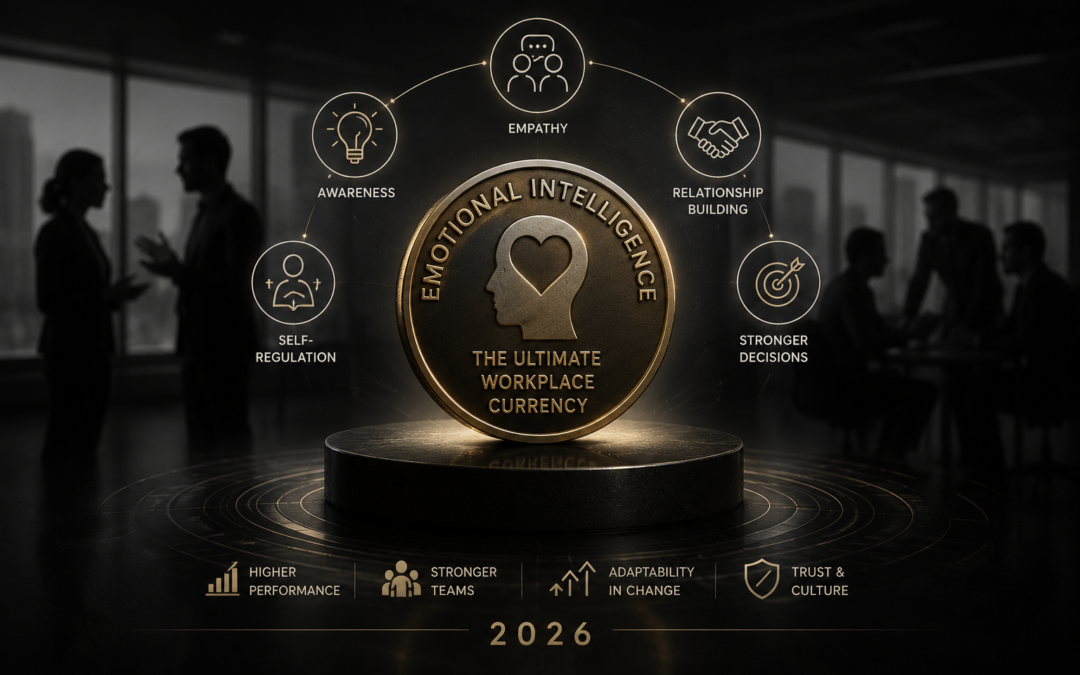
For most of the last two decades, the career math in India was simple: pick a technical skill (coding, data analysis, financial modelling, engineering), get good at it, and the market pays you more than the person next to you who didn't bother. That equation is now breaking, and every professional and every HR leader in the country needs to notice before it breaks them.
AI is eating the technical execution layer of knowledge work: code, financial models, legal document review, customer service scripts. It's fast, decent, and cheap. What's left over, and rising fast in value, is what AI still can't touch: reading a room, managing conflict without setting the room on fire, inspiring people through ambiguity, building real trust. Emotional intelligence, in plain terms.
What the Data Actually Shows
These numbers aren't India-specific or US-specific, they come from global research, but they're worth sitting with. TalentSmartEQ, one of the largest EQ assessment providers in the world, has found that emotional intelligence accounts for roughly 58% of job performance across every type of role it has studied. Ninety percent of top performers score high on EQ. Only 20% of the weakest performers do.
The market is treating this as more than a nice-to-have. The global emotional intelligence training and assessment market was valued at roughly $868 million in 2021 and is projected to grow at over 25% a year through 2030. Separately, Capgemini's Research Institute found that global demand for EQ skills was on track to rise sixfold within five years as automation took over routine technical work. In India, you can already see this playing out: coaching, leadership development and interpersonal skills programmes have become one of the fastest-growing categories in corporate training.
Why Technical Skill Alone Doesn't Cut It Anymore
This argument gets misread a lot, so let's be precise. AI isn't replacing technical skill, it's lowering the cost of good-enough technical execution. A developer who used to take three hours to write clean code had a real edge over a colleague who needed six. Today, both of them can get comparable output in under an hour with AI doing the heavy lifting. The quality gap between them hasn't vanished, but the visible output gap has shrunk to almost nothing.
The same thing is happening in financial analysis, market research, content creation, basic legal work, and a growing list of other knowledge jobs. AI keeps raising the floor of what counts as competent. The ceiling, the work that needs real judgement, creative insight, ethics, and the ability to manage people through ambiguity, stays stubbornly human.
Call it the hybrid intelligence premium if you like labels: the professionals winning in 2026 aren't the ones who ditched technical skills for people skills. They're the ones doing both, AI fluency for execution, high EQ for strategy and influence. They can build the model and read the room. Write the code and hold a team together through chaos. Run the analysis and then actually get the organisation to act on it, which usually comes down to trust, not logic.
Why India Has Historically Undervalued EQ
India's education system and corporate culture have long treated technical and academic achievement as the only currency that matters. Entrance exam ranks, grades, certifications, that's been the ladder from school to the C-suite. "Soft skills" got filed under nice-to-have, something you pick up later if you have spare bandwidth.
That bias shows up as a real gap at the top of Indian organisations. Plenty of senior leaders got there on technical excellence alone, and a fair number never developed the self-awareness or interpersonal range to lead through ambiguity, build psychological safety, or manage complicated stakeholder relationships, all things strategic work actually demands. Gallup's State of the Global Workplace research found that South Asia, driven largely by India, saw an eight-point drop in manager engagement in 2025, the steepest decline of any region measured worldwide. That's not a soft-skills footnote. That's a leadership capability problem showing up in the data.
It's not a stretch to connect that number to retention. When managers can't read a room or handle a hard conversation without damaging trust, people leave, and they rarely write "my manager has low EQ" on the exit form. Technical talent can be rehired. A culture people actually want to stay in is much harder to rebuild once it's gone.
What High-EQ Leadership Actually Looks Like
Emotional intelligence gets mistaken for being nice or expressive. It's more specific than that. Daniel Goleman's original framework, still the standard in corporate assessment, breaks it into five parts: self-awareness (knowing your own emotional states and how they land on others), self-regulation (managing your reactions instead of just having them), motivation (drive that doesn't depend on someone else clapping for you), empathy (accurately reading what other people are feeling), and social skill (using all of the above to actually move people).
You can spot high-EQ managers in India by specific habits, not vibes: they give feedback that targets the problem, not the person. They name team anxiety out loud during uncertain periods instead of pretending it isn't there. They explain their reasoning instead of just issuing decisions. They sponsor their people's careers instead of guarding their own turf. And they hold themselves to the same standard they hold everyone else to. None of this is a personality trait you're born with, it's a set of behaviours you can build, which is the most useful thing the research tells us.
Building EQ: What Actually Works
EQ can be developed. Unlike IQ, which holds fairly steady across adulthood, emotional intelligence responds to deliberate practice. The catch is that a one-day workshop won't do it. The research is consistent here: it takes ongoing feedback, reflection, and actually practising different behaviour, over months, not an afternoon.
For Indian organisations building this at scale, three things matter more than the rest. First, assess before you train. Most companies throw people into EQ workshops without measuring where they actually stand. Running a validated instrument (EQ-i 2.0, the Mayer-Salovey-Caruso test, or similar) before designing a programme means you're fixing a real gap instead of running a generic soft-skills session. Second, invest in coaching for senior leaders specifically. Group workshops move the needle less than confidential, one-on-one coaching at the top, and because senior EQ has ripple effects across an entire team or company, the return on that investment is outsized. Third, make EQ visible in how you manage talent. If it's not part of performance conversations, promotions, and hiring decisions, it stays a poster on the wall. Put it in your leadership competency framework and succession planning, and people will notice what you actually value faster than any training deck will tell them.
Where This Is Headed
By 2026, emotional intelligence has stopped being a leadership development nice-to-have and become a basic competitive requirement. The organisations winning the talent war aren't the ones with the toughest technical hiring bar. They're the ones that built a culture people actually want to show up for: psychological safety, real recognition, managers who see them. None of that happens by accident. It gets built deliberately, by HR functions that understand the most valuable thing they can create in an AI-heavy workplace is somewhere good to work.
For working professionals in India, the takeaway is straightforward. Keep building your technical skills, they're still necessary. They're just no longer enough on their own. The real premium in 2026 goes to the people who are as deliberate about their human skills as they've always been about their technical ones.